Showing posts with label Caleb Mutfwang. Show all posts

Sep 1, 2026

Human Eyes, Divine Motive

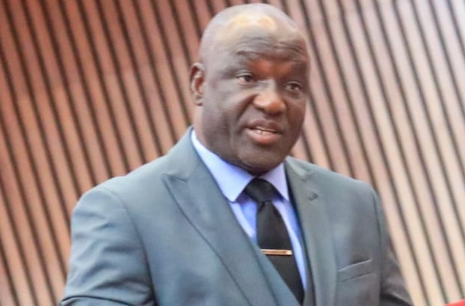
Hon. Peter Kanang Gwom. Source: Gwom's Facebook Picture Library

On Friday, 28 August, an event was held at the conference hall of the Plateau State Head of Service's office. It was in honour of the then Commissioner of Environment, Climate Change and Mineral Development, Honourable Peter Kanang Gwom, who was leaving his portfolio to assume office as the new Commissioner of Lands, Survey and Town Planning.

A month earlier, a stray thought had crossed my mind: What happens if the Commissioner is taken away? It was not based on any rumour I had heard—just a quiet premonition that wandered in uninvited. Then, it came to pass. In a major cabinet reshuffle by Governor Caleb Mutfwang's administration, Honourable Gwom was moved to the Ministry of Lands, Survey and Town Planning.

Why was I fearful? Over the years, we have had a series of commissioners, each with their own idiosyncrasies. Some were difficult to work with; we often prayed for their departure—whether through reshuffle or resignation. We rarely cared when a bad commissioner left. But this time, the fear was different.

My second concern stemmed from the wealth of experience Honourable Gwom had accumulated during his three years at the Ministry of Environment. In that time, he attended conferences from Cape to Cairo, Somalia to Gambia, and everywhere in between. He also initiated and completed beautiful projects. This built for him a towering expertise in environmental matters. His transfer meant he was taking that expertise away from a ministry that needed it one hundred percent, to one that required very little of it. To my human eyes, this looked like a loss.

In his farewell speech, the Commissioner cited moments when he had wanted one thing, but something else came his way. Eventually, he said, he came to understand that what came was actually in his best interest. He remarked that humans often look at events "with human eyes," missing the divine motive behind them. That phrase stayed with me.

Reflecting on this, I recalled that a former long-serving Permanent Secretary of the Ministry of Environment—who had also been moved to Commerce—was now heading to the same Ministry of Lands, Survey and Town Planning. This coincidence suggests that perhaps the Ministry of Lands has pressing issues that require people with environmental insight. What seemed like a subtraction may, in fact, be a strategic redeployment. But we could not see it—not with human eyes.

Still, no experience gained is ever wasted while you are alive. The greatest challenge our planet faces today is the threat of environmental doom, unless we act to reverse or build resilience to climate change. That is why we must build strong momentum in this fight—and it is a fight for everyone, whether in government or outside it. Governments design policies; the private sector cooperates to achieve goals. Early in his tenure at the Ministry of Environment, Honourable Gwom was quoted as saying there was too much redundancy and that he wanted to see things happen. That passion defines his approach to any role. His drive suggests that even outside government, his experience could still be put to meaningful use.

Perhaps the real weakness is not in what we see, but in our assumption that what we see is all there is. You never know when the tide of life is leading you to a destination that will benefit you and humanity. Often, you gain experience without immediately seeing the full picture—but eventually, the pieces fall into place. The divine motive, hidden from human eyes, slowly reveals itself.

And when it does, you realise: you were never really losing. You were being repositioned


Jun 13, 2025

Beyond the Plateau Climate Assembly

Picture source: seaart.ai

The Plateau State Ministry of Environment, Climate Change and Mineral Development hosted the Plateau Climate Assembly. It was a gathering of Plateau people from across the country to study the Plateau State policy on the climate agenda, a policy document that is praised for being the only one of its kind across Africa. There was the need to study the document to identify possible loopholes that would need to be sealed before it is passed into law.  That was the aim of the assembly.


For many, it is something that aims to re-energize the pride they have always had for Plateau State. Plateau State built for itself the reputation of being a forerunner throughout the forty-nine years of its history. We see this in its iconic schools, its role in the development of the media in northern Nigeria, its role in its contribution to sports development in Nigeria, not forgetting its vibrant urban culture that others wished they had.  


So, how did Plateau end up with a document that is the onliest across Africa? It surely comes from the calibre of the Commissioner of the Ministry of Environment, Climate Change and Mineral Development, Peter Kanang Gwom. He is a man who understands that politics is a power struggle, but that power is a means to an end, rather than the end itself. He is known to be restless when there is inactivity in the ministry, contrary to what is obtainable in other places, where people are paid and expected to be thankful for not doing anything, while they get paid.  


The desire to get things done saw Honourable Gwom travelling around the world, attending meetings with hues of environmental discussion. These global interactions and connections surely paved the way for the idea of the Plateau Policy on Climate Change, something that is sure to radiate across the country and Africa at large.


When the Plateau Policy on Climate Change is eventually passed into law, the action of plugging into the fight against climate change and mitigating its impact is expected to begin.


Across Nigeria, the World Bank is currently training people on social and environmental standards. This is a training that had been conducted in the past, but the World Bank is repeating it because it observes that Nigerians are not ploughing into the global climate efforts. Thus, passing the Plateau policy document into law is only the first hurdle.


What has been responsible for the inability of Nigerians to join the war against climate change, despite the agonizing experience of the impact of climate change? We have seen it in the desperation of herders trying to find fresh grazing lands, having been driven by desertification in the north of the country. We have seen it in alien crop diseases and irregular rainfall patterns that are frustrating agricultural yields. We have seen it in the floods that buried our towns and cities in the past couple of years. Thus, it is shocking why Nigerians continue to dawdle over the climate issue.


Educated people blame the uneducated for not believing the reality of climate change. It is a case of the kettle describing the pot as grimy. It is the duty of the educated to enlighten the uneducated to believe the reality of climate change, even if it means doing so in their native languages –not having formal education is not an implication of dysfunctional mental faculties.


The onus rests solely on us, the educated. The educated demography in the private domain must support the government to shape policies that accelerate our efforts towards mitigating the impact of climate change. The educated private sector must support government efforts to end cutting down trees for firewood and charcoal, activities that exacerbate the damage to our environment. The private sector must support governments in the area of setting up environmetal grant makers in the country to encourage innovators working to bring green alternatives that replace technologies that impair our environment.


While nations are setting dates for bidding farewell to the use of fossil fuels, governments across the country request support to not just key in but also find alternative sources of income when the transition is finally actualized. Geological explorations must aim to find safer mineral alternatives, which will be exploited and used responsibly.


We are already late on the climate issue.

Dec 24, 2024

The Magic of Diket Plang


Senator Diket Plang. Source: Pang's Facebook Gallery

Plang has always beaten his chest saying he never had to worry much about writing applications with the intention of seeking a job –his only applications where to the people from whom he sought political mandates.

Very early from graduation, he opted to be in politics, becoming a counsellor representing one of those words from Pankshin South. He eventually rose to coordinate the National Poverty Alleviation Programme under Joshua Dariye, who was the Governor of Plateau State between 1999 and 2007. During the Jonah Jang administration as the Governor of Plateau State, Senator Plang became an adviser to the Governor on Inter-Governmental Matters. That was when I knew him, following an interview he granted me while I worked actively as a journalist at the time. During the second tenure of the Jang administration, he successfully contested for the state assembly and won. In the eight years of Simon Lalong, he went into hibernation. At the end of it, he bounced back, this time as a Senator.  He taught us that patience is a powerful weapon in political strategy.

Obviously, there is something magical about his political life, given that he comes from a marginal tribe in Pankshin, where the Ngas are the largest tribe –our political culture is largely driven by sympathy to people with whom we share a common ancestry or religion. We cannot forget too easily that we are in the era of the Muslim-Muslim tag.  

So, what is the secret blueprint he has used to stay relevant all these decades? It is obviously, his generosity. I was prompted to write this after listening to what he had done to people in his constituency by given out one thousand bags of rice to folks at the bottom of the economic hierarchy. Roughly, that amounts to about one hundred million naira, a largesse one can describe as staggering!

There was a time, early in Plang’s senatorial incumbency. It was when he was invited to inspect the Nigerian Institute of Mining and Geosciences in Jos with the intention of helping with a bill seeking to make the institute a university.  I went there and watched as he was been taken round the institute.  I thought it was a near-impossible task, but the man eventually delivered, a restatement of his laser-sharp political wit.   

This big-heartedness has been the recipe to his unvarying political victories. His detractors say that he has been succeeding by bribing the people with generosity. Anything wrong with that?  –politics is about irritability to the troubles of the people, helping the people to accomplish their individual and shared dreams.

Having became a Senator, there is just one rung atop the latter that he hasn’t attained. It is the position of a governor. Unfortunately, when he ends his tenure as a senator (assuming he wins the second tenure) it will be the turn of Northern Plateau to present the candidates. That is if we stick to the agreement which merely comes from our convictions that power should rotate. It is not a clause in the constitution and anything can happen. From his antecedents, it is dangerous to underestimate what the Senator is capable of actualizing.

Dec 3, 2024

The Yeshua Kingdom Foundation International

The Yeshua Kingdom Foundation International, Jos

The Yeshua Kingdom Foundation International is an open-air centre of religious gatherings. It was built in Jos by Jonah David Jang, a man who has been a governor in three of Nigeria’s thirty-six states.  It is located between Doi and Ladura villages in the Du District of Jos South. People have come to refer to the monument as the Ten Commandments because of the spectacle of a giant tablet on which the Ten Commandments of God are engraved. The monument, built from Jang’s personal funds, was commissioned by erstwhile President Goodluck Jonathan in December 2021. Jang had ended his time as governor in 2015 and as a senator in 2019.

In addition to President Goodluck Jonathan, who commissioned the monument, two former presidents of Nigeria, Olusegun Obasanjo and Yakubu Gowon, have also walked the soil of the monument. Obasanjo and Gowon were special guests at the maiden edition of a three-day inter-denominational event, which concluded on December 1st, 2024, following the request of Governor Caleb Mutfwang, the current Governor of Plateau State. The coming of Generals Gowon and Obasanjo accentuated the epic standing of the monument –the event enjoyed record attendance, only comparable to the attendance recorded when Reinhardt Bunke visited Jos in the mid-1990s. 

The Ten Commandments is set in a picturesque location of Du District. It is designed such that the colourful sitting positions form a bow pattern, which faces an elevated podium behind which the tablet stands. The tablet’s giant size compares to human sizes as Gulliver compared to Lilliputians. The arena also boasts of water pools designed for baptism and have been used for that purpose since the inauguration of the monument.

Sometimes in 2010, I visited Makurdi, the capital city of Benue State and noticed the roads were curiously wide and dichotomous. They were also flanked by giant gutters that lessen any possibility of flooding. When I observed that the construction pattern was identical to what Jonah Jang was building in Plateau State, my host confirmed that the roads were actually built by Jonah Jang while he was the military Governor of Benue State. It is this obsession for urban renaissance that has helped Jang to become so powerful that he decides who becomes the governor of Plateau State.

When Jang’s construction turbo took off on the Plateau in 2007, it was relentless and ubiquitous under the Plateau sun, compelling President Goodluck Jonathan to stay for three days, flying across the state and commissioning a stack of projects Jang had piled within a short period of becoming governor. The roads at the heart of the construction were aimed at spreading the physical developments to all corners of the state as much as possible. This was so achieved until the end of his second tenure in 2015. Building the monument with his private funds makes obvious his undying love for Plateau State. The record attendance of the religious event has proven that when constructions spread further away from the city centre, they spur developments in the countryside.  

Within the short period Caleb Mutfwang has been in the state as the Governor, he has been able to demonstrate that he is a protégé of Jonah Jang. The volume of his projects despite the litigations that slowed him in the first year proves this. Mutfwang, who understands the role such monuments play in stirring prosperity, moved around with a broad smile on his face, greeting everybody. It is said that governance is a process, not an event. Unfortunately for Plateau State, this is only true if the People's Democratic Party is in charge. Clearly, the Mutfwang approach is a continuation of what Jang stands for.

There is something iconic about Yeshua Kingdom Foundation International: the monument carries an ambience that is reminiscent of the happy days last seen in the mid-1980s. As far as this is concerned, everyone on the Plateau is upbeat

Staying away from power is like walking into the distance. The more you walk away, the less distinct you become. The more years Jang stayed away from the government house, the more indistinct he became in the minds of Plateau people. However, building the Yeshua Kingdom Foundation International from the leftovers in his pouch has brought him back to the notice of the people in a manner that is so distinct that time will find it difficult to erode.

The constant prayer in the minds of kind-hearted people in Plateau State is for Jang to live long. Clearly, God is answering this prayer. 

Human Eyes, Divine Motive

Hon. Peter Kanang Gwom. Source: Gwom's Facebook Picture Library On Friday, 28 August, an event was held at the conference hall of the Pl...